Fluent in the Unspoken: The Psychological Architecture of Elite Companion Intuition
There is a particular moment that seasoned travelers to Istanbul describe with striking consistency. It arrives not at the beginning of an evening, not during its most dramatic peak, but somewhere in the quiet middle — when they realize, with mild astonishment, that their companion has already understood something about them that they hadn't yet understood about themselves. The conversation has turned precisely where they needed it to turn. The silence has lasted exactly as long as it should. The evening has shifted, without announcement, from what was planned to what was actually required.
This is not coincidence. It is craft.
The Invisible Curriculum
Elite companionship, at its highest tier, operates on a form of social intelligence that psychologists might classify as advanced mentalizing — the capacity to model another person's internal state with accuracy and responsiveness. What distinguishes premium companions in Istanbul's international marketplace is that this capacity has been refined through sustained practice across an extraordinarily diverse range of clients, cultures, and emotional registers.
American travelers, in particular, often arrive carrying a specific kind of psychological freight. The professional pressures of the US business culture — the relentless performance orientation, the expectation that even leisure must be optimized — can manifest in subtle but legible ways. A certain tightness in the shoulders during the first hour. A conversational pattern that defaults to accomplishment narratives before relaxing into genuine exchange. A tendency to over-schedule the evening as a hedge against the discomfort of open time.
A companion who has worked extensively with international clientele learns to read these patterns not as personal quirks but as a kind of emotional dialect. The translation happens quietly, and the response is calibrated accordingly — not to what the client has requested, but to what the situation is actually asking for.
The Three Registers of Unspoken Communication
Investigating how this intuition operates in practice, several distinct channels emerge through which information flows between a client and a skilled companion before explicit communication has even begun.
Physical register. Body language remains the most immediate and least filtered channel of human communication. The pace at which someone moves through a room, whether they position themselves facing an exit or settling into a space, how they hold a glass — these micro-signals transmit volumes. An experienced companion doesn't catalog these observations consciously so much as absorb them into an ongoing, real-time assessment of what the evening requires. A client who arrives moving quickly and speaks in clipped sentences is communicating something categorically different from one who arrives slowly and scans the room before sitting.
Conversational threading. The topics a person gravitates toward in early conversation, and crucially the ones they approach and then retreat from, form a kind of narrative map. Elite companions develop an acute sensitivity to these patterns — noting not just what is said but what is nearly said, what is raised and then deflected, what seems to carry disproportionate emotional weight. These threads, followed carefully, lead toward the experiences and exchanges that will feel most genuinely satisfying.
Temporal cues. How a client relates to time during an engagement reveals a great deal about their underlying state. Someone who checks the time frequently may be anxious about the evening's structure. Someone who seems to lose track of time entirely may be experiencing a quality of presence they rarely access in their daily life. Skilled companions use these temporal signals to modulate pacing — accelerating or decelerating the rhythm of the evening to match what the client's psychology is actually capable of receiving.
When Intuition Becomes Architecture
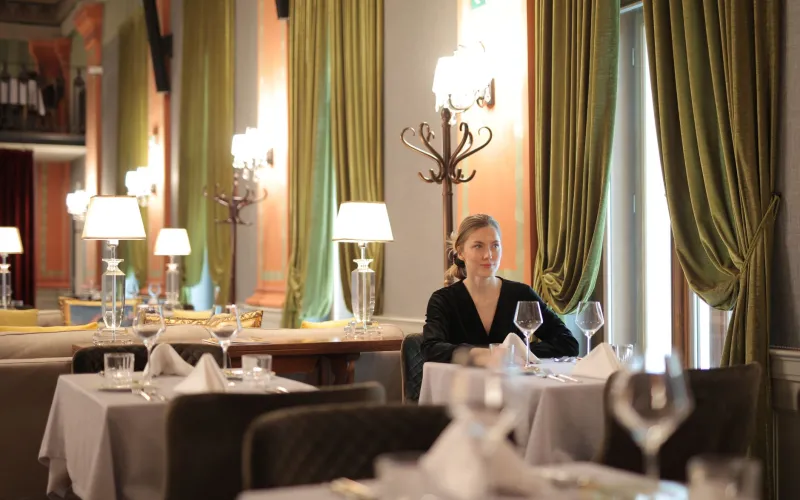
Consider a scenario that illustrates how these channels converge. An American executive arrives for an evening engagement following a difficult day of negotiations. He has requested a dinner at one of Istanbul's premier Bosphorus-facing restaurants — a sophisticated choice that signals taste and an appreciation for setting. He arrives punctually, is impeccably dressed, and is immediately articulate and socially fluent.
A less attentive companion might take these surface signals at face value and proceed accordingly — lively conversation, the performance of a successful evening. But a more perceptive companion notices something underneath the fluency: a slightly over-controlled quality to the humor, a conversational pattern that stays relentlessly in the present tense, never reaching backward or forward. The polish, in other words, is working very hard.
Rather than matching the surface energy, the companion gently shifts register — introducing a slower conversational pace, asking questions that invite reflection rather than performance, allowing the silences to breathe rather than filling them. By the middle of the evening, the executive has relaxed into something more genuine. The experience he walks away from is not the one he thought he wanted when he made the reservation. It is considerably better.
This recalibration — from the stated preference to the actual need — is the signature move of truly elite companionship. It requires not just perceptiveness but a particular kind of confidence: the willingness to gently redirect an evening even when the client has not signaled any dissatisfaction with its current course.
The Empathy Paradox in Luxury Experiences
There is an interesting paradox at the center of this skill set. The companions who are most adept at anticipatory presence — at understanding and responding to unspoken needs — tend to be those who have developed genuine curiosity about other people as a baseline orientation. This is not a technique that can be convincingly performed without the underlying disposition.
For the American traveler accustomed to service environments where attentiveness is scripted and formulaic, encountering this quality of genuine interest can be disorienting in the best possible way. It produces the sensation, rare enough in contemporary life, of being actually seen — not as a category of client or a type of traveler, but as a specific person with a specific inner life.
This is, ultimately, what the premium tier of the companionship market is selling, even when it is nominally selling something else. The dinner, the conversation, the social ease — these are the vehicles. The destination is that rarer experience of authentic human attunement.
What This Means for the Discerning Client
For American travelers considering Istanbul's elite companionship offerings, understanding this dimension of the experience carries practical implications. The companions operating at the highest level of this market are not simply well-dressed and well-spoken — they are, in a meaningful sense, sophisticated practitioners of applied social psychology.
This means that the quality of the experience is partially a function of what the client brings to it. Arriving with genuine openness — a willingness to be read, to be gently redirected, to allow the evening to become something other than what was scripted in advance — creates the conditions under which this level of attunement can actually operate.
The unspoken agenda, it turns out, is always the most interesting one. The companions who have mastered the art of hearing it are the ones worth seeking out.