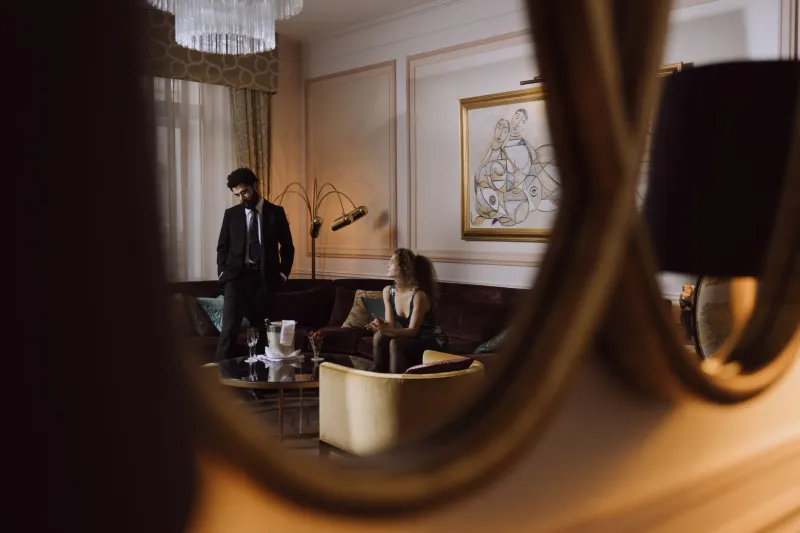
Reading the Room: The Subtle Science Behind How World-Class Companions Adapt to Every Moment
There is a particular kind of intelligence that does not appear on a résumé. It cannot be credentialed, catalogued in a profile, or adequately described in a directory listing. Yet among the defining qualities that separate a forgettable encounter from a genuinely transformative one, it may be the most consequential of all. That quality is the capacity to read a room — not in the theatrical sense of commanding attention, but in the far more nuanced sense of perceiving invisible signals, registering emotional temperature, and adjusting one's entire approach in real time, without a single word being exchanged.
For the international clientele who travel to Istanbul in search of elite companionship, this skill is the difference between an experience that feels rehearsed and one that feels, improbably, like it was designed specifically for them.
The Limits of the Script
Many people who have never engaged with truly high-caliber companionship assume that the experience operates on a kind of predetermined logic — that companions arrive with a fixed repertoire, deploy it systematically, and depart. This assumption fundamentally misunderstands what makes elite companionship valuable.
A scripted approach is, by definition, inattentive. It privileges what the companion has prepared over what the client actually needs in a given moment. And clients, particularly those accustomed to high-stakes professional environments, notice the difference immediately. The American executive who has spent a decade reading boardrooms, the attorney trained to detect hesitation in witnesses, the entrepreneur who has learned to trust his instincts about people — these individuals are not easily fooled by performance. What they respond to is presence. Genuine, calibrated, responsive presence.
Elite companions understand this intuitively. The most accomplished practitioners in Istanbul's competitive market have largely abandoned the scripted model in favor of something far more demanding: radical attentiveness.
Micro-Signals and What They Reveal
The science of nonverbal communication has documented, across decades of research, that human beings transmit enormous quantities of information through channels they are largely unaware of. Micro-expressions — fleeting facial movements lasting fractions of a second — betray emotions that the conscious mind may be actively suppressing. Postural shifts signal comfort or discomfort before the individual has processed either feeling cognitively. Changes in vocal cadence, breath rhythm, and even the pace at which someone reaches for a glass can indicate whether the emotional temperature of a room is rising or falling.
Top-tier companions have, through experience and often through deliberate study, developed a heightened sensitivity to precisely these signals. They are not reading minds. They are doing something more practical and, in many respects, more impressive: they are paying attention with a quality of focus that most people reserve only for situations of high personal stakes.
For American clients arriving in Istanbul — frequently jet-lagged, sometimes emotionally guarded, often carrying the residue of demanding professional lives — this attentiveness is experienced not as surveillance but as relief. Someone is genuinely noticing them. Not performing interest, but demonstrating it through behavior.
The Pivot: Adjusting Without Announcement
What distinguishes a truly skilled companion from one who is merely perceptive is the capacity to act on what she observes — fluidly, without drawing attention to the adjustment itself. This is the art of the pivot.
Consider a common scenario: a client arrives presenting as relaxed and convivial, but within the first twenty minutes, his responses become shorter, his posture subtly closes, and he begins checking his phone with the distracted frequency of someone whose mind is elsewhere. A less attentive companion might push through the established social register, growing louder or more animated in an attempt to recapture momentum. An elite companion recognizes the signal for what it is — not disinterest, but overload — and shifts register entirely. The conversation quiets. The physical space expands slightly. The energy in the room drops a half-degree, deliberately, creating the conditions for the client to decompress rather than perform.
This kind of adjustment is invisible precisely because it is executed with skill. The client does not experience it as a tactical maneuver. He experiences it as comfort — as the rare sensation of being in the company of someone who simply gets it.
Emotional Intelligence as Professional Currency
Within Istanbul's elite companionship market, emotional intelligence has become something close to a primary professional currency. This is not accidental. The city's international clientele — which skews heavily toward experienced, discerning travelers from the United States and Western Europe — has become increasingly sophisticated in its expectations. These clients have, in many cases, engaged companionship services in multiple cities across multiple continents. They have reference points. They know what mediocre feels like, and they are willing to pay significant premiums to avoid it.
What they are paying for, when they select from Istanbul's upper tier, is not a fixed set of physical attributes or a predetermined social agenda. They are paying for adaptability. For the confidence of knowing that whatever emotional state they arrive in, their companion will meet them there — not force them toward some other state that is more convenient or more comfortable for her.
This is a demanding standard. It requires not just perceptiveness but a particular kind of professional stability — the ability to absorb and reflect a wide range of emotional registers without becoming destabilized by any of them.
What Clients Can Do to Facilitate the Dynamic
It would be a mistake to frame real-time emotional attunement as a purely one-directional phenomenon. The most successful encounters are collaborative, even if the client is not consciously aware of his role in the dynamic.
Clients who arrive with some degree of self-awareness — who have taken even a few minutes to consider their actual emotional state before the encounter begins — make their companion's work significantly more productive. This does not mean arriving with a rehearsed mood or a curated persona. It means arriving with honesty, even if that honesty is only internal. Acknowledging to yourself that you are tired, or tense, or unexpectedly melancholic, creates a kind of openness that skilled companions can detect and respond to far more effectively than a performed cheerfulness that masks something else entirely.
The best encounters, by nearly every account from Istanbul's elite clientele, are those in which both parties are genuinely present — in which the companion's attentiveness finds a corresponding willingness in the client to be seen accurately rather than impressively.
The Istanbul Advantage
There is something about Istanbul itself that seems to cultivate this particular form of interpersonal sophistication. A city that has functioned as a crossroads of cultures for centuries, where the negotiation of difference is woven into daily life, tends to produce individuals with finely calibrated social antennae. Istanbul's elite companions have grown up in an environment where reading people accurately is not a professional skill but a social survival mechanism — and that depth of experience shows.
For American travelers making the journey, the encounter with this level of attentiveness can be genuinely disorienting in the best possible sense. It challenges the assumption, common in a culture that prizes self-presentation, that being known requires extensive disclosure. In the right company, in this city, you may find yourself understood with a precision and a care that requires very little explanation at all.